Commissioning of the Laboratory of Energy, Resources and Energy Efficiency
- Monday, Jul 06 2026
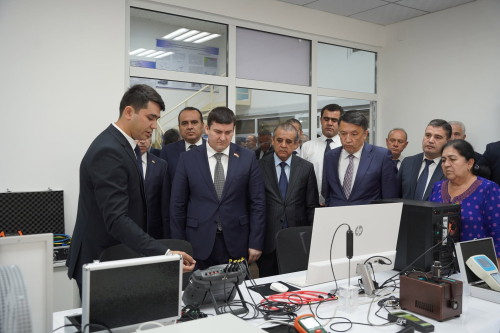
Today, July 6, on the occasion of the 35th anniversary of the State Independence of the Republic of Tajikistan and the declaration of 2026 as the “Year of Expanding Improvement and Construction Activities and Strengthening National Identity and National Self-Awareness,” the new modern Laboratory of Energy, Resources and Energy Efficiency was commissioned at the Institute of Water Problems, Hydropower and Ecology of the National Academy of Sciences of Tajikistan with the participation of the President of the National Academy of Sciences of Tajikistan, Academician Khushvakhtzoda Qobiljon Khushvakht, as well as other scientists and researchers.
During the opening ceremony, it was stated that the Laboratory of Energy, Resources and Energy Efficiency is one of the important research units of the Institute of Water Problems, Hydropower and Ecology, and focuses its activities on the study, analysis and implementation of modern energy technologies, improving the efficiency of energy resource utilization, and promoting energy efficiency.
Under current conditions, when the issues of ensuring energy security, saving electricity, rational use of resources, and reducing energy losses have become particularly important, the activities of such a laboratory are of high scientific and practical value for the Republic of Tajikistan.
It was noted that the laboratory is equipped with a range of modern measuring, monitoring and analytical instruments. In particular, power quality analyzers make it possible to analyze the main parameters of electrical networks, including voltage, current, frequency, active and reactive power, power factor, as well as load variations and network stability. Using such equipment, specialists can identify the causes of electricity losses, deterioration in power quality, and instability in the operation of electrical equipment.
It was also noted that the laboratory uses a thermal imaging camera designed for the thermal inspection of power equipment, cables, connections, motors, transformers and other technical components. This equipment makes it possible to detect overheating points before accidents occur. The use of this method plays an important role in preventing failures, increasing equipment reliability, and ensuring energy security.
Another area of the laboratory’s activity is the study of the operation of generators and independent electricity generation sources. An experimental generator is used to test engine operating modes, fuel consumption, the stability of electricity generation, and its suitability for operation under various load conditions. This type of research has practical significance for regions that require backup power sources.
To analyze environmental impacts and technical emissions, the laboratory is also equipped with a gas analyzer. This device is used to determine the composition of gases and assess emission levels during the operation of engines, generators and other energy equipment. The results of such analyses are important for evaluating combustion efficiency, reducing environmental impacts, and developing scientific recommendations for the safe operation of energy equipment.
In the field of renewable energy research, particularly solar energy, the laboratory uses specialized equipment to measure solar radiation parameters, test the efficiency of solar panels, and evaluate their operating conditions. These studies provide a scientific basis for the development of green energy, the appropriate selection of solar technologies, and improving their efficiency under the climatic conditions of Tajikistan.
At the same time, testing equipment is used to assess stability, technical condition, vibration, temperature and other performance indicators of energy systems. With the help of these tools, laboratory specialists can evaluate the actual condition of equipment and provide well-founded recommendations for its proper operation, timely maintenance, and reduction of energy costs.
The laboratory’s activities are aimed not only at conducting scientific research but also at implementing scientific results in practice. It provides opportunities to carry out energy studies for institutions, enterprises, social and industrial facilities, determine the level of energy losses, assess the condition of equipment, and identify ways to improve energy efficiency.
Using modern equipment and scientific methods of analysis, the Laboratory of Energy, Resources and Energy Efficiency can contribute to the following areas: assessment of power quality, technical diagnostics of energy equipment, research on renewable energy sources, analysis of generator efficiency, reduction of energy losses, improvement of energy efficiency, and development of scientific recommendations for the sustainable development of the energy sector.
Overall, this laboratory, as a modern scientific and practical center, can contribute to the development of the national energy sector, the efficient use of resources, the introduction of new technologies, and the strengthening of the energy security of the Republic of Tajikistan. With these capabilities, the laboratory holds a significant position in advancing energy science and implementing innovative solutions.
Press Center NAST